
A collaborating physician may be physically located in another state in some telehealth or remote-oversight arrangements. Physical location is only one part of the analysis. The physician’s licenses, the NP’s authority, the patient’s location, the state definition of collaboration, prescribing, chart review, and any proximity or presence conditions can all affect the answer.
A telehealth collaborating physician should therefore be evaluated state by state and service by service. Remote oversight is not the same as remote patient care, and an out-of-state address does not automatically disqualify or authorize the physician.
Doctors For Providers can help identify candidates for collaborating physician matching after the practice maps the relevant states and responsibilities. Use this guide to prepare the questions that should be verified with boards and qualified healthcare counsel before patients are scheduled.
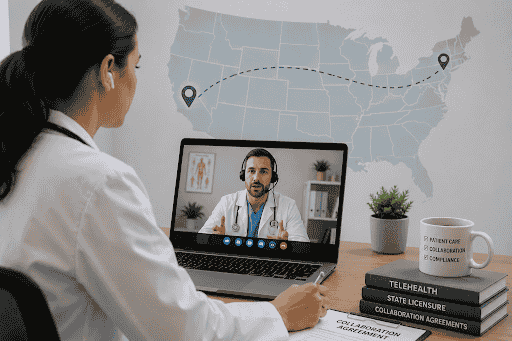
Start With Three Locations, Not One
Cross-state planning begins by identifying where each participant is located. The NP may work from one state, the collaborating physician may work from another, and the patient may join a telehealth visit from a third. Different rules can attach to each role and location.
- NP location: Where the NP is physically practicing and which license or privilege supports the work.
- Physician location: Where the physician is physically located and which state licenses or authorizations the physician holds.
- Patient location: Where the patient is physically located during a telehealth encounter, which commonly drives the patient-state licensure analysis.
The practice should verify patient location for each telehealth visit because travel can change the applicable state. Federal telehealth guidance lists several cross-state pathways, including a full license, temporary practice law, reciprocity, compact privilege, or telehealth registration when available. None should be assumed to apply without checking the profession and state.
Separate Remote Oversight From Telehealth Patient Care
A collaborating physician can provide remote oversight without personally delivering telehealth visits to the practice’s patients. The physician may review charts, discuss cases, review protocols, meet with the NP, or provide consultation under the agreement. Those activities are distinct from diagnosing or treating a patient through telehealth.
This distinction matters for in-person clinics as well. An NP may see patients at a physical practice while the physician supports the relationship remotely. The state may treat collaboration, supervision, medical direction, and patient care differently, so use the correct role terminology.
Verify the Physician’s State License and Eligibility
A key starting question is whether the physician holds the license or other authorization required for the state connected to the NP arrangement. Some jurisdictions may focus on licensure, while others may add eligibility, specialty, distance, availability, relationship limits, agreement, or filing conditions. Check the current medical board and nursing board rather than relying on a candidate’s home-state license.
Record the license number, source, status, expiration, restrictions or public notices, reviewer, and next check date. If the arrangement spans several patient states, create a row for each state and avoid treating one verification as national coverage.
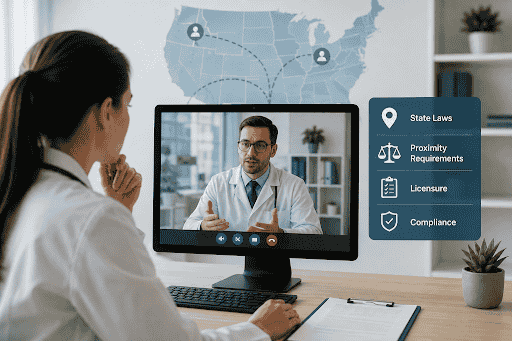
Check Whether Physical Presence or Proximity Matters
A state may permit remote communication yet still impose conditions involving geographic proximity, periodic in-person meetings, site visits, availability, or emergency coverage. Another state may require in-state licensure without requiring the physician to live there. The answer can also differ between collaboration and a medical-director role.
Ask a narrow question: What does the current authority say about where the physician may be located and how the required relationship functions for this NP, service, and practice site? Qualified counsel can help interpret language that is unclear or spread across multiple rules.
Do Not Treat a Compact as Automatic Permission
Licensure compacts can streamline an application process, but they do not create one unrestricted national license. Depending on the compact, a provider may have to meet eligibility conditions, obtain a target-state license or privilege, pay applicable fees, and follow the target state’s laws. A compact can be enacted before privileges are operational.
The compact question also depends on profession. The Nurse Licensure Compact applies to RN and LPN/VN licensure and should not be treated as authorization for advanced-practice work performed as an NP. Check the applicable APRN pathway, state boards, and implementation status before scheduling.
Review Prescribing as a Separate Workstream
Permission to collaborate remotely does not settle prescribing. The practice may need to evaluate professional scope, patient-state rules, the collaboration agreement, controlled-substance requirements, clinician-patient relationship standards, pharmacy rules, and federal law. Noncontrolled and controlled medications may be treated differently.
Federal telemedicine prescribing policy is time-sensitive. HHS and DEA have extended certain temporary telemedicine prescribing flexibilities for controlled medications through December 31, 2026. That extension does not replace state law, professional scope, legitimate-medical-purpose requirements, or other federal conditions. Verify the current rule at publication and before launch.
Build Privacy and Remote Chart Review Into the Model
An out-of-state physician may need secure access to charts, protocols, quality reports, or clinical messages. Define the purpose and level of access and apply appropriate access, documentation, and termination controls based on the systems used and applicable privacy and security requirements. The HIPAA remote chart review guide explains how to separate convenience from a controlled workflow.
A secure platform does not solve licensure, and a valid license does not solve privacy. Treat them as separate items with separate owners, evidence, and renewal dates.
Use a State-by-State Verification Checklist
A short state matrix makes the arrangement easier to review. Do not rely on one national yes-or-no field. Consider recording the official source and review date for each state-specific conclusion.
- NP license, compact privilege, registration, or other authorization
- Physician license and eligibility for the relationship
- Patient-location verification process
- Collaboration, supervision, delegation, or medical-direction terminology
- Physical-presence, distance, meeting, and availability conditions
- Agreement, filing, notice, or approval process if applicable
- Chart-review, documentation, prescribing, and privacy workflow
- License, agreement, insurance, and registration renewal dates
Common Ways an Out-of-State Arrangement Breaks Down
Problems often begin with a correct general idea applied to the wrong facts. A state may permit remote collaboration, but the physician lacks the relevant license. The physician may be licensed, but the agreement does not cover the service. The agreement may be valid, but the patient is located in another state or the prescribing plan changed.
- Assuming the physician’s home-state license transfers to the NP’s state
- Checking licensure but not eligibility, relationship limits, or proximity conditions
- Using one agreement for multiple states without state-specific review
- Confusing remote physician oversight with telehealth patient treatment
- Ignoring the patient’s location during a telehealth encounter
- Treating controlled-medication rules as the same as general telehealth rules
- Failing to monitor license, agreement, and insurance renewals
Prepare the Practice Before Requesting a Match
Provide the target states, NP credentials, patient locations, service menu, prescribing plan, expected volume, practice locations, telehealth platform, chart-review expectations, availability needs, and target date. Identify which conclusions came from boards or counsel and which remain open.
Doctors For Providers can use those facts to identify physician candidates licensed in relevant states and aligned with the planned services. The practice should still verify the final state-specific structure and agreement. For broader expansion planning, review the Doctors For Providers cross-state telemedicine licensing guide.